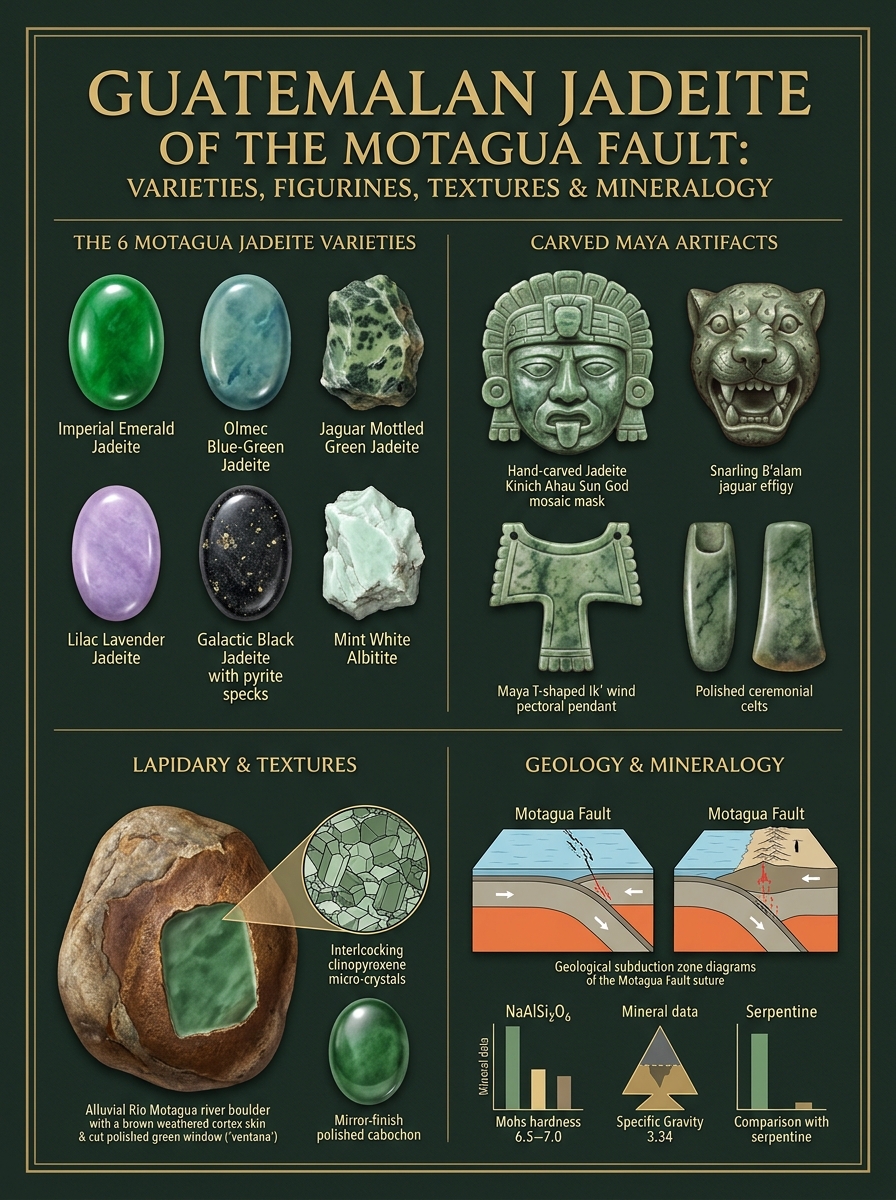
Imperial Emerald Jadeite
Semi-translucent to translucent vivid emerald green. Found in thin, high-grade veins inside alluvial boulders; reserved for fine cabochons and royal Maya earflares.
Chromophore: Chromium (Cr³⁺ → Al³⁺)
To the Classic Maya and Olmec, *Ya'axtuun* (greenstone/jadeite) was more sacred than gold—symbolizing the maize sprout, water, and the immortal breath of the soul (*Ik'*).
Unlike Chinese jade (which was historically fibrous **Nephrite** amphibole until Burmese jadeite imports in the 18th century), 100% of authentic Guatemalan jade from the **Motagua River Fault Zone** (`El Progreso`, `Zacapa`, `Jalapa`) is true **Jadeite (`NaAlSi2O6`)**—forged under 10–20 kilobars of subduction pressure where the Caribbean and North American plates collide.
Pure jadeite (`NaAlSi₂O₆`) is snow-white; every color in the Motagua Valley comes from specific trace-metal substitutions during high-pressure metamorphism.
Semi-translucent to translucent vivid emerald green. Found in thin, high-grade veins inside alluvial boulders; reserved for fine cabochons and royal Maya earflares.
Misty, ice-blue to seafoam-teal jadeite unique to Guatemala's southern Motagua tributaries. Prized by Olmec master carvers (1200–400 BCE) for ceremonial celts and masks.
Deep pine and forest green mottled with dark omphacite and chromite rosettes. The signature stone of Classic Maya royal funerary masks at Tikal, Palenque, and Calakmul.
Pastel orchid-violet to deep lilac jadeite with visible sugary crystal flashes. Discovered in southern Motagua tectonic lenses and prized for contemporary silver/gold settings.
Dense omphacite-jadeite infused with microscopic graphite, magnetite, and golden pyrite stars. Polishes to a liquid-mercury mirror luster; ideal for incised Cholq'ij Nawal medallions.
Snow-white sodium-aluminum jadeite and albite swirled with delicate ribbons of bright mint green—recording the exact boundary where chromium-bearing fluids entered pure jadeitite.
Single cobbles preserving multiple metamorphic fluid pulses: emerald green, pale lavender, snow white, and russet iron veins frozen together in one specimen.
Alluvial Río Motagua cobbles whose outer layer oxidized over millennia into warm russet, honey, and crimson—carved in relief so the red skin becomes a macaw's wing or solar halo.
From Preclassic string-sawn Olmec celts to living Highland Cholq'ij Nawal medallions carved in San Marcos and Antigua workshops.
Characterized by square-spiral solar eyes, prominent Roman nose bridge, lateral jade earflares, and the T-shaped filed front tooth representing *Ik'* (solar breath).
Carved from mottled Jaguar Green jadeite so the stone's natural black chromite inclusions form the pelt rosettes of the underworld nocturnal sun.
The stepped-T glyph (*Ik'*) worn over the sternum of Maya rulers to channel wind, music, life-breath, and the resonant voice of the ancestors.
Personal birth-day cartouches (*B'atz'*, *E*, *Aj*, *I'x*, *Tz'ikin*, *No'j*, *Tijax*, *Ajpu*...) incised into Galactic Black or Imperial Green discs with matte-frosted relief.
Petaloid axes and concave water-talisman spoons carved from translucent Olvido Blue jadeite that ring like a bronze bell when suspended and struck.
Sinuous relief carvings that follow natural bright-emerald chromium veins winding through darker river jadeite.
How raw river-tumbledjadeitite looks and feels at every stage of inspection and carving.
Rough, oxidized brown-russet skin formed as boulders tumble down the Río Motagua. Looks like an ordinary river rock from the outside, except for its unmistakable heavy heft (SG 3.34).
A diamond saw slices a small flat corner window through the brown cortex. Wetting the cut reveals the internal green saturation, crystal grain, and depth of translucency.
On a fresh unpolished break, Guatemalan jadeite sparkles with tiny, blocky interlocking clinopyroxene crystals ('mosca' or sugary texture)—unlike nephrite's matte fibrous felt.
Diamond-polished to 50,000 grit. Under angled light, slight hardness differences between interlocking crystal orientations create the diagnostic 'orange-peel' micro-surface of real jadeite.
How to distinguish true Motagua Jadeite (`NaAlSi₂O₆`) from Chinese/BC Nephrite and softer Serpentine ("New Jade") in seconds.
| Property / Test | Guatemalan Jadeite (True Jade) | Nephrite Jade (China / BC / NZ) | Serpentine ('New Jade' / Imitation) |
|---|---|---|---|
| Mineral & Formula | Sodium-Aluminum Clinopyroxene (NaAlSi₂O₆) |
Calcium-Magnesium Amphibole (Ca₂(Mg,Fe)₅Si₈O₂₂(OH)₂) |
Hydrous Magnesium Phyllosilicate ((Mg,Fe)₃Si₂O₅(OH)₄) |
| Mohs Hardness & Steel Knife Test | 6.5 – 7.0 · Steel blade (5.5) slides off without scratching; can scratch glass. | 6.0 – 6.5 · Resists steel knife; slightly softer than jadeite. | 3.5 – 5.0 · Steel knife point leaves a visible white powder scratch. |
| Specific Gravity (Palm Heft) | 3.24 – 3.43 (Heavy, dense planetary feel) | 2.90 – 3.03 (Medium-heavy) | 2.50 – 2.65 (Feels noticeably light) |
| Internal Structure & Luster | Interlocking blocky micro-crystals; vitreous/glassy mirror luster with subtle orange-peel dimpling. | Micro-fibrous matted bundles; waxy-to-greasy mutton-fat luster. | Scaly/platy sheet silicates; waxy or resinous surface feel. |
| Color Palette | Imperial Emerald, Olmec Blue-Green, Jaguar Green, Lavender/Lilac, Galactic Black, Snow White. | Spinach green, mutton-fat cream white, olive-brown, black. | Yellow-olive, chartreuse, pistachio green with cloudy white/black streaks. |